| BizBridges |  |
Home / BizBridges /
|
|
|
 |
| Management/ Strategy |
| Book Review: The Post American World by Fareed Zakaria |
| Author : | thedesk |
| Institute : | |
| Posting Date : | 06/08/08 |


|
|
|
| Total 14 vote(s). |  | |
|
|
|
|
|
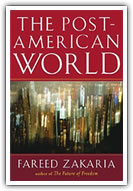
A review of Fareed Zakaria’s recent book -The Post American World talks about how the world will be defined less by pro or anti Americanism and more by rising powers like China and India, even though the US will continue to have the best higher education opportunities, defense technology, research and entrepreneurs.
|
|
|
Recommendations: TheDesk Recommends
Excerpt 1
“I went to elementary middle, and high school in Mumbai, at an excellent institution, the Cathedral and John Connon School. Its approach (thirty years ago) reflected the teaching methods often described as Asian, in which the premium is placed on memorization and constant testing. I recall memorizing the vast quantities of material, regurgitating it for exams, and then promptly forgetting it. When I went to college in the United States, I encountered a different world. While the American system is too lax on rigor and memorization – whether math or poetry – it is better at developing the critical faculties of the mind, which is what you need to succeed in life. Other educational systems teach you to take tests; the American system teaches you to think.
It is surely this quality that goes some way in explaining why America produces so many entrepreneurs, inventors, and risk takers. In America people are allowed to be bold, challenge authority, fail, and pick themselves up.“
Fareed Zakaria’s recently released book -The Post American World - is a thought provoking and lucid description of a world that has emerged in the years after the cold war and a recommended read. He describes this period as a momentous one in world history as this, according to him, is the third big power shift in 500 years of world history; after the rise of the western world and the British hegemony followed by the coming to power of the Americans after World War II.
Zakaria's central theme in the book is that the changes that are occurring in this world are a result of the rise of powers like India and China. This is due to the result of dynamic events in the economic and political landscapes that have shaped the world in the last few years. These countries that lagged behind in terms of political confidence and pride are now discovering them. In his first chapter titled "rise of the rest," he talks about why one should focus on the rest of the world, even though the US remains in a position to be hugely influential.
His angle of analysis stems from a hypothesis that such a change will not necessarily be caused by the collapse or decline of the United States, but despite its presence. In this aspect, he articulates a version that will emerge in which the US remains a major political and military power, but also has to contend with some important players like China and India. He sees India as more of an ally while China, he feels, is likely to pose a greater challenge to the global influence of the US. He favours openness rather than imposing barriers that only reflect insecurity and uncertainty, and argues that the biggest challenge for America is not terrorism or China, but rather its own lack of flexibility to adapt successfully to the changed environment.
During the early part of the Iraq war, Fareed Zakaria wrote in the Newsweek that the world would be defined by pro- or anti-Americanism. However, he seems to have changed his thinking over a period of time, given the continuation of the hostilities in Iraq and the growing economic influence of India and China. He feels that from talking pro- or anti-Americanism, the world needs to move towards post-Americanism.
Comparisons are inevitable with Thomas Friedman’s The World is Flat. In this regard, one must say that the biggest difference lies in where the authors came from. While Friedman writes from the perspective of an outsider who marvels at India’s growth, Zakaria who’s been born and brought up in Mumbai in India, articulates the perspective of one who’s had to grow up in socialist India and has thereafter witnessed the change and rise of this nation from far away America. He brings a more grounded perspective and a certain inevitability to the trajectory of progress that India represents today.
Excerpt 2
“As someone who grew up in India, I have a healthy appreciation for the virtues of its famous engineering academies, the Indian Institute of Technology (IIT). Their greatest strength is that they administer one of the world’s most ruthlessly competitive entrance exams. 300 000 people take it, 5000 are admitted – an acceptance rate of 1.7% (compared to 9 to 10% for Harvard, Yale and Princeton).
The people who make the mark are the best and the brightest out of one billion. Place them in any educational system and they will do well. In fact, many of the IITs are second rate, with mediocre equipment, indifferent teachers and unimaginative classwork. Rajiv Sahney, who attended IIT and then went to Caltech, says: The IITs’ core advantage is the entrance exam, which is superbly designed to select extremely intelligent students. In terms of teaching and facilities, they really don’t compare with any decent American technical institute.”
Interestingly, Zakaria bases his future perspective upon historical narratives and present contexts. The period when Britain held sway as a world power is also discussed and compared to the present state of the US. He argues that the fundamental point remains that Britain was undone as a great power not because of bad politics but because of bad economics. He draws parallels between Britain’s decline that started with the Boer war (a waterloo for a powerful nation after their victory in a war before that), and America’s situation in Iraq (also coming after it had run over Afghanistan). The difference between the two, he points out is that while Britain ruled the seas but never the land, the US in contrast, dominates at every level – land, air, seas and air space and accounts for almost 50% of global defence spending. Add to this the inherent scientific and technological edge that America possesses, and the military gap between America and others is a huge one.
There are some sweeping generalizations emerging from broad assessments of scenarios. He writes that Chinese officials accept that their country still lags behind the US in many areas, and therefore poses very little threat. It will be naïve to take such a comment to be a microcosm of the official Chinese worldview. Possibilities of military interventions by China in other parts of the world in order to establish a greater indirect challenge to the US cannot be ruled out. Being a thinker of political science, Zakaria was expected to provide a more nuanced political analysis that assesses strategic shifts in regional and global alliances and the future impact of the Chinese in the Middle East, on oil trade and in Africa vis a vis the US.
The greatest strengths of the book is the ability of the author in stringing together isolated facts and integrating them to form a strong analysis and vindicate the arguments he presents. For instance, he writes that policies of free trade, liberal immigration, change and openness – which constitute the core of this global metamorphosis, are no longer cordially received in America. To vindicate this view, Zakaria notes that in 2007 when the Pew Global Attitudes Survey polled citizens in 47 countries for purposes of measuring the extent to which they have positive views about free trade and open markets, the US finished last. He laments this fact about the US; that having extolled liberal and democratic values for 60 years, "we are becoming suspicious of the very things we have long celebrated," when the rest of the world has decided to take the advice.
Zakaria highlights some stunning figures – on how China's economy has doubled every eight years and how India may have the world's third largest economy by 2040, or how India still moves forward resolutely despite having 40% of the world’s poor, or even though it adds a Nigeria each year – over 3 million people below a dollar a day or even though its government sleeps while the industry adds value. Also, he talks about how the US has certain inherent advantages – it has accounted for roughly a quarter of the global output for over a century, it still has the best education system, the most willing set of entrepreneurs and risk takers and recounts his own example and other examples to corroborate his viewpoint.
Zakaria argues that America's world-beating economic vibrancy co-exists with a dysfunctional political system. "A 'can-do' country is now saddled with a 'do-nothing' political process, designed for partisan battle rather than problem solving," he writes.
America policy should emulate Bismarck rather than follow the policy of wartime Britain, and thus aspire to move into a balancing role where it has the greatest leverage across different camps and countries.
In his conclusion he doesn’t hide how America has defined his personal landscape and impacted his thoughts. He has a strikingly simple yet interesting prescription about what America needs to do to thrive in a new and challenging world. He says it should be a place that is as inviting and exciting to the young student who enters the country today as it was for an awkward eighteen year old a generation ago.
Perhaps that’s Zakaria’s ode to the land of opportunities that has touched him. That’s besides his ode to the developing world, where he spent his formative years learning about a Post American World.
, |
| Total 14 vote(s). | | |
|
|
|
|
|
 | Messages/Opinions |
|
|
| | No messages yet! Be the first one to post a message here. |
|
Click Here to login and post message
|
| Indian Alumni and Students from the following Indian and Global Institutes are invited to be members of 6bridges.com: |
| |
| India |
| Business & Accounting Institutes : FMS, ICAI, IIFT, IIM(A), IIM(B), IIM(C), IIM(I), IIM(K), IIM(L), IRMA(Anand), ISB, JBIMS, MDI(Gurgaon), NITIE, NMIMS, SJMSOM(IIT Bombay), SPJIMR, TISS, XIMB, XLRI |
| Technology Institutes : BIT(Mesra), BITS(Pilani), COE-Guindy(Anna Univ.), DCE, IISc, IIT(B), IIT(M), IIT(D), IIT(G), IIT(K), IIT(Kgp),IIT(Roorkee), ISI(Kolkatta), ISM (Dhanbad), IT-BHU, Jadavpur Univ., National Institutes of Technology(RECs), PSG(Coimbatore), RVCE(Bangalore), VJTI |
| |
| Global |
| Business, Technology & Accounting Universities/Institutes : AGSM(Sydney), AIM(Manila), Caltech, Carnegie Mellon, Columbia, Cornell, Dartmouth, Duke, Georgia Tech, Harvard, ICAEW(UK), IMD(Switzerland), INSEAD, Judge(Cambridge), London Business School, Manchester, Melbourne Business School, Michigan, MIT, Northwestern, NYU, Princeton, Purdue, Queen's(Canada), Said(Oxford), Stanford, U.Chicago, U.Penn, UC Berkeley, UCLA, Univ. of Illinois-Urbana, Univ. of Southern California, Univ. of Virginia, Warwick, Yale |
|
|